
Ivaylo Naydenov
Institute for Historical Studies –
Bulgarian Academy of Sciences
https://doi.org/10.53656/his2026-2-1-mer
Abstract. The aim of the current article is twofold. On the one hand, brief, otherwise important information regarding the life and long-lasting entrepreneurial activities of Tsvyato Radoslavov Kane (Sahatchiev) (1820-1880) has been presented.
Tsvyatko was born in Gabrovo into a wealthy (merchant) family. His relatives managed to establish lucrative trade contacts with Wallachia and Moldavia, as well as with the Austrian monarchy, in the first years of the 19th century. What is more important is that their experience and connections have passed to the next generation, whose representative is Tsvyatko. Around the 1840s, he decided to move to the Danubian town of Svishtov in order to expand his entrepreneurial ventures. He managed to establish several commercial enterprises. Despite his bankruptcy, he managed to revive and to expand his economic activity. As a result, Tsvyatko had the opportunity to amass significant fortunes.
The second aim of the paper proposed is to shed light on Tsvyatko’s testament drafted in the early spring of 1876. Currently, the document is stored in the collections of the Historical Museum in Svishtov and has not been subject to thorough scientific analysis. The will gives him the opportunity to reveal additional and little-known aspects of his personality, family, and private life.
The text of the primary source (the will), provides hints about Radoslavovʼs kin (about his wife Kiriakitza, his sisters, and adopted son Tsvetan Radoslavov-Hadjidenkov); about his charitable donations to schools (in Svishtov and in the native Gabrovo); about Tsvyatko’s desire to help financially needy individuals; one can find, albeit briefly, data on Radoslavov’s movable and immovable properties (a house, café, two shops, money, an inn, vineyards, fields, and meadows); last but not least, there are some clues about the executors (Kostaki G. Avramov and Georgi h. Denkov) of the will, who were also representatives of the entrepreneurial elite in Svishtov.
In general, the will provides valuable details about the life and last wishes of an open-minded, entrepreneurial person. As a representative of the Bulgarian (and the Balkan) bourgeoisie, he was actively involved in various public activities, thus contributing to the process of modernization of the Bulgarian society during the National Revival period.
Keywords: Bulgarian National Revival period; Tsvyato Radoslavov Kanev (Sahatchiev); commercial activities; testament
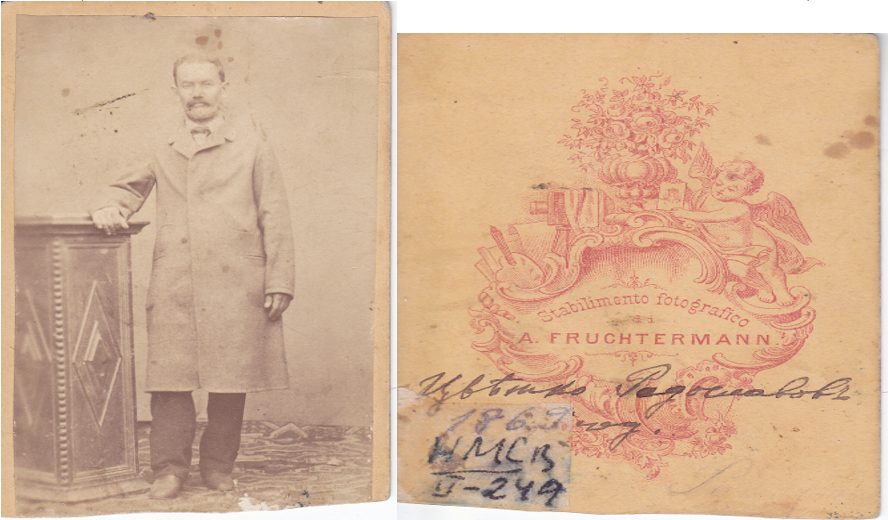
The aim of the text proposed is to shed light on the will of one of the most prominent representatives of the entrepreneurial elite in Svishtov during the Bulgarian National Revival period – Tsvyato Radoslavov Kanev (Sahatchiev) (more about the commercial elite in Svishtov in: Drumeva 2016c, pp. 103 – 118; Rusev, 2015, pp. 444 – 451; Naydenov 2021, pp. 28 – 46; Naydenov 2025, pp. 141 – 176 and quoted sources) (see Appendix 1). He was born on 20th October 1820 and passed away on 2nd October 1880 (more about his life and economic activities in: Pophristov 1931, pp. 125 – 127; Danailova 1944, pp. 1 – 72; Kosev 1974, pp. 618 – 619 and the detailed research made by: Drumeva 2007, 2010, 2013, 2014, 2016a, b, c, 2017, 2018; Arshinkov 2002, pp. 22, 57 – 63; Nikolova 2008, p. 383; Rusev, 2015, pp. 446 – 449; Marinova 2019, pp. 154 – 155, 168 – 169; Naydenov 2023, pp. 163 – 166). Throughout his entire life, Tsvyatko earned his living through diverse economic activities (commission trade and trade for his own account, tax farming, etc.)[1]. He was an open-minded person eager to take risks across diverse economic activities. He learned continuously – from his personal and professional experience, which was severe in some cases. Such negative practice, in its turn, served as a necessary lesson for him to restore and to broaden his business. Moreover, he was actively involved in numerous public (charitable) activities in Svishtov. He was responsible for the distribution of Georgi Rakovski’s books and newspapers in the Danubian town. Tsvaytko also participated in the foundation of the Svishtov Reading Room (chitalishte) in January 1856 (Pophristov 1931, pp. 126 – 127; Arshinkov 2002, pp. 62 – 63; Nikolova 2008, p. 104, 105, 134 – 135, 142, 144 – 145, 149 – 150, f. 66, 219, 298, 383, 385, 418 – 419; Savova 2021, pp. 80 – 86 and quoted sources). Tsvyatko Radoslavov was an indicative example of the Bulgarian (and Balkan) bourgeoisie (in general). Its representatives were often people with modest levels of education who desired to initiate and develop their own work. In doing so, they were eager to adopt and use commercial novelties in their practice. They adopted European dress (see: Appendix 1 in the case of Tsvyatko Radoslavov), manners and behaviour, etc. (Dertilis 1995, pp. 111 – 128; Danova 2004, pp. 11 – 13; Davidova 2013; Davidova 2015, pp. 47 – 62).
The document (Radoslavov’s testament) is dated March 1, 1876. To my knowledge, it has only been mentioned briefly in the PhD thesis written by Mariana Drumeva (Drumeva 2018, p. 118). The will is not even mentioned in the fundamental book written by Sava Velev “Golden book of the benefactors of national education” (Velev 1907). It is not presented or analysed in detail, in sharp contrast to the extensive research and publication of such primary sources in foreign (Romanian) historiography (see, for instance, Lazăr 2021a, b).
In the beginning of my paper, I will try to present briefly Tsvyatko Radoslavov’s personality and entrepreneurial activities. I will outline the main directions of his long-standing entrepreneurial practice, after which I will present important and interesting data regarding his property status. In the second part, the main focus will be on Radoslavov’s will from 1876.
Tsvyatko Radoslavov Kanev (Sahatchiev) was born in the settlement of Gabrovo in a merchant and well-to-do family. His father’s name is Radoslav. Tsvyatko’s grandfather is Kunyo (Kuncho) Sahatchiev. The above-mentioned Kunyo and his brother Genyo were prominent entrepreneurs in Gabrovo in the late 18th and early 19th centuries. They managed to amass significant fortunes through the export of large quantities of craft and agricultural items (padlocks, paper, hides, cotton yarn, rice, silk, etc.) in the Danubian principalities, and in Central Europe in the first years of the 19th century (Tsonchev 1996 [1929], p. 392, 408, 410 – 411, 415, 416, 418, 439, 441 – 443, 443, footnotes 1 and 3 on p. 443, 455, 458, 471 – 472; Rusev, 2015, p. 322; Drumeva 2018, pp. 117 – 118).
Probably, Tsvyatko used the contacts, capital, and moral support of his relatives to initiate his own economic activity in his native Gabrovo (Drumeva 2018, pp. 117 – 118). However, later (around 1840) he settled down permanently in Svishtov. The reason for his decision was the idea to expand his economic activity and the family’s network (Drumeva 2018, p. 119). Due to the economic expansion of the Austrian monarchy (Austro-Hungary from 1867), more intensive trade contacts between the Balkans and Central Europe took place on the Lower Danube (Paskaleva 1986, pp. 103 – 243). As a result, such settlements (as Ruse, Svishtov, etc.) attracted more people with entrepreneurial spirit from elsewhere (see, for instance, Naydenov 2025, p. 151 and quoted sources in f. 38; Yaneva 2011, pp. 257–258). Moreover, Tsvyatko’s cousin Hristo Sahatchiev settled in Zimnicea (the town in front of Svishtov, in Romania) where he dealt with commission trade between Ottoman Bulgaria and Wallachia (later Romania) (Drumeva 2018, p. 119).
In Svishtov, Tsvyatko married the daughter (Kiriakitsa) of Atanas Ikonomov – a prominent merchant from the town of Svishtov (Nikolova 2008, p. 298, 385; Yaneva 2011, p. 262; Drumeva 2018, pp. 119 – 120). Initially, Tsyatko run mutual trade with Atanas Ikonomov. Later, during the 1850s – 1870s, he (Tsvyatko Radoslavov) managed to establish and run one of the prosperous commercial houses that developed its activities between the Bulgarian lands, Wallachia and Moldavia (later Romania), and in Central Europe (see abundant details in: Danailova 1944, pp. 40–57; Drumeva 2007, 2010, 2014, 2016a, b; Drumeva 2018, pp. 120 – 380).
It is known that Tsvyatko Radoslavov Kanev (Sahatchiev)’s education was scarce, but his commercial knowledge, gained from practice, was significant, as it is evident from Tsvyatko’s different kinds of business records. He used and scribbled commercial correspondence, mercantile ledgers, bills of exchange, contracts, and brief notes on the quantities of the items traded. He even drafted some official letters in which he explained his view on some business disputes with his counterparts. He and his partners (Ahmet h. Ismailov) possessed their own seals in order to stamp their letters and other documents. Obviously, despite the not very high and/or specialized (commercial) education, he was familiar with various commercial and financial techniques, and with the Ottoman commercial law (see: Pophristov 1931, p. 125; Danailova 1944, pp. 40 – 57; Yaneva 2011, pp. 254 – 255; Rusev, 2015, pp. 446 – 448; Naydenov 2025, pp. 155 – 156, 158).
Radoslavov practiced export and import commission commerce on both shores of the Danube River, and traded for his own account. Initially, in the 1840s, he began to trade with hides, grain and craft items. Later, Tsvyatko Radoslavov’s social/entrepreneurial network extended to various settlements in present-day North and South Bulgaria. From there, Radoslavov exported large quantities of rice, processed leathers, and other items, which he forwarded through Svishtov to various clients in Zimnicea, Alexandria, Bucharest, Brăila, Galaţi, Craiova, Turnu Magurele, etc. He also managed to establish business contacts with the powerful Bulgarian firms located in Istanbul, “Hristo P. Tapchileshtov” (1852) and “Dimcho S. Karaminkov” (1853) (Drumeva 2018, pp. 120 – 380; Naydenov 2023, pp. 163 – 164).
After the Crimean War (1853 – 1856), Radoslavov suffered serious economic and financial problems, as was the case with many other enterprising Bulgarians. Moreover, in the summer of 1859, Radoslavov declared bankruptcy, but he was able to resume his business activities again within a short time. He became a partner with some rich and influential Muslims. Moreover, he expanded the geographical scope of his business in Brăila, where he opened an office branch of his commercial entreprise in 1861. His decision should be considered a vital step, because in the 1860s and 1870s, Brăila grew into one of the economically thriving Romanian ports from which large exports of grain were made (Davidova, pp. 55, 74 – 75; Drumeva 2018, pp. 212 – 380).
Moreover, it is evident that during this time frame Tsvyatko and/or his agents/partners constantly travelled in order to negotiate with other merchants or peasants the quantities of wheat, barley and corn needed. We can find Tsvyatko and his agents in the region of Svishtov, Nikopol, Oryahovo, Tarnovo, Sevlievo, etc. with this purpose (Drumeva 2007, pp. 23 – 50).
The information scattered across several documents from the period 1877 – 1879 can provide insights into Radoslavov’s large-scale business dealings. On one hand, he traded actively with salt. This item was bought in Romania by Ivan Stoyanov, known as the “Salt Merchant”[2]. Through Stoyanov’s intermediation, around 60,000 – 70,000 okka of salt were imported into Svishtov (Drumeva 2014, pp. 66 – 82). Moreover, in October 1879, Tsvyatko signed a contract to sell 2000 kg of wheat to Ivancho Stoyanov from Guergevo[3].
It is evident that Radoslavov, along with other rich and influential Bulgarian merchants, invested accumulated financial resources in tax farming after the Crimean War. He participated in several joint ventures with Christian and Bulgarian entrepreneurs, investing substantial financial resources. Such economic activities were profitable but otherwise risky and could harm their practitioners (Davidova, pp. 57 – 65; Drumeva 2010, pp. 36 – 49; Yaneva 2011, pp. 162 – 164, 188, 217 – 223).
Through his long-standing and large-scale entrepreneurial activity, Tsvyatko Radoslavov managed to accumulate significant financial resources. According to an inventory of his immovable property, he was the owner of a house, a casino, a shop, an inn in the Wallachian neighbourhood in Svishtov, a café, fields, vineyards and gardens. Moreover, his property was valued at 95 150 guruş[4] (Yaneva 2011, pp. 283 – 284).
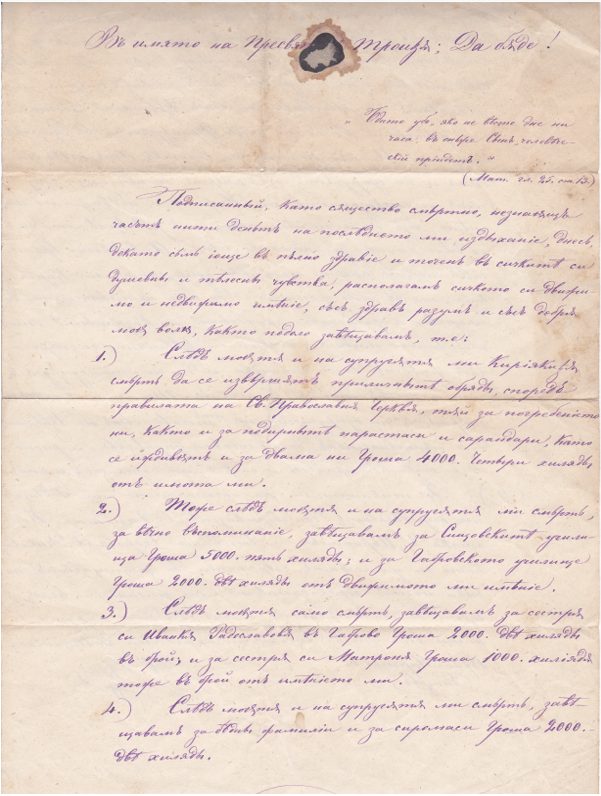
His will is currently stored in the archival collections of the Historical Museum – Svishtov[5] (see Appendix 2). It is two pages of handwritten text in Bulgarian. It was drafted in the early spring of 1876 in the town of Svishtov. It consists of one brief introduction, six terms, the date and Radoslavov’s signature. In the Introduction, Radoslavov points out that at the date of signing the will (March 1st 1876), he was in good health and of sound mind. He also explains the reasons for drafting the document. It can be said that the introductory part is more or less the same as some earlier samples of other already known wills. (Davidova 2013, p. 140).
In the 1st term, Radoslavov points out that after his death and the death of his wife, Kiriakitsa, the appropriate Christian (Church) rights should be performed according to the rules of the Holy Orthodox Church, for their burial, as well as for the subsequent memorial services and tributes. For this purpose, he leaves by his will 4 000 guruş.
It could be said that the presented data, as well as other sources suggest, secularization took place among the representative of Bulgarian bourgeois. However, it does not mean marginalization of Christian religion. As Nadia Manolova – Nikolova points out, “the rational, understood as modern thinking, and religious views actually coexist, often in an unstable state of tension, with periods of strong reaction against rationalism, with a revival of religiosity, and vice versa” (Manolova – Nikolova 2016, p. 20).
In 2nd term it is noted that after Radoslavov’s and Kiryakitsa’s death, for eternal remembrance, Radoslavov donated 5 000 guruş to the schools in the town of Svishtov. Moreover, Radoslavov donated more 2 000 guruş to the Gabrovo school from his movable property.
There is no information for Tsvyatko’s donation to the Gabrovo school in the exhaustive monograph on the public and cultural life in Gabrovo written by Petar Tsonchev (Tsonchev 1996 [1934]). The mentioned author is quite familiar with various donations made by persons born in Gabrovo who have settled abroad. However, Tsvyatko’s case is not among them (Tsonchev1996 [1934], pp. 390 – 485, 642 – 674).
There are several details which are worth additional comment. First of all, it is evident that Tsvyatko Radoslavov continued a long-lasting practice of donation of significant financial resources for secular educational institutions in the Danubian town of Svishtov (Nikolova 2008, pp. 83 – 109, 145 – 152, 160 – 178, 230 – 449; Drumeva 2016c, pp. 104 – 110). On the other hand, he did not forget his native urban setting of Gabrovo, which can be characterised as local patriotism. It was typical of other Balkan Orthodox merchants from the 18th to the late 19th century (Davidova 2013, pp. 139 – 143).
Moreover, the given information clearly shows a shift from donating to religious institutions (churches and monasteries) to the foundation and operation of secular schools, the printing of (text)books, newspapers, and magazines (Davidova, pp. 139 – 147). Among Bulgarians, the tradition of donating to religious institutions persisted until the mid-19th century. Yet as early as the beginning of the 19th century, a new, more secular mindset had already begun to emerge among entrepreneurs in towns such as Svishtov and Gabrovo. It can be assumed that such a rational way of thinking emerged as a result of intensive trade contacts with the Danubian Principalities and Central Europe, as reflected in the practice of making significant donations for secular education (Krustanov 1978, pp. 132 – 139; Nikolova 2008, pp. 124, 145).
In the 3rd clause of the will, there are interesting facts related to the family of Tsvyatko Radoslavov in Gabrovo. The names of his sisters are mentioned – Ivanka and Matrona. Radoslavov bequeathed them 2000 and respectively 1 000 guruş. Unfortunately, we do not have any additional sources regarding the aforementioned ladies.
The 4th point states that after the death, Radoslavov and his wife’s 2,000 guruş should be given to poor families and poor men. This is clear evidence that, along with the progressive elements in Radoslavov’s testament, there are some remnant practices from the past. In this case, philanthropic gestures to the needy people. It was a common practice, which is evident from the samples of wills included in epistolary guides and wills of Balkan merchants from the previous decades (see, for instance, Davidova 2013, pp. 139 – 140).
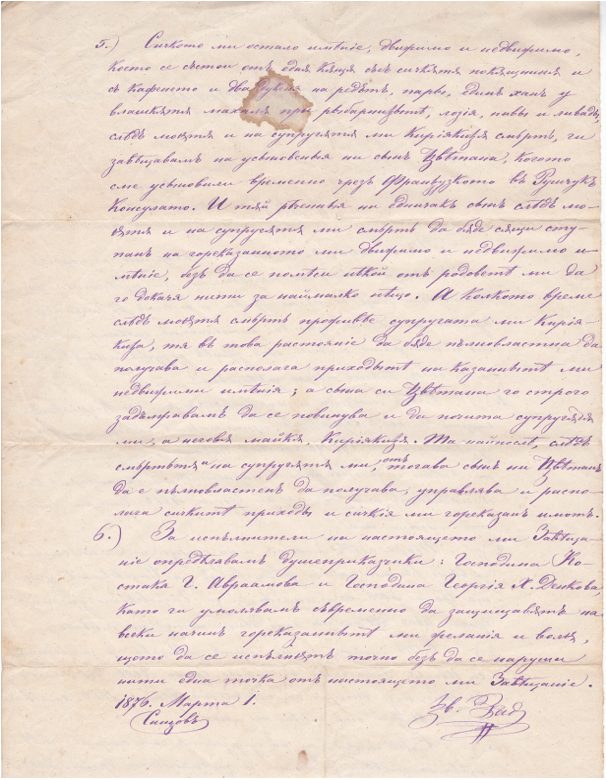
In the 5th clause Radoslavov points out that all his remaining property (movable and immovable), which consists of a house with all the furnishings and the café, and two shops on the street, money, an inn in the Wallachian neighborhood in Svishtov, vineyards, fields, and meadows. After his and his wife’s (Kiriakitsa) death, Radoslavov bequeathed to their adopted son Tsvetan, “whom we have temporarily adopted through the French Consulate in Ruse”, all the mentioned properties.
The adopted son Tsvetan Radoslavov-Hadjidenkov, born in 1863, is son of Paunika Hristaki Pavlovitch and Georgi Hadjidenkov. After the death of Paunika’s parents, she (Paunika) was adopted by Tsvetan Radoslavov Kanev and his wife Kiriakitsa. Later, as is evident, he (Tsvetan Radoslavov Kanev) adopted the firstborn son of Paunika, who was named Tsvetan after his mother’s stepfather. Other sources also suggest that Tsvyatko Radoslavov Kanev accompanied the young Tsvetan in Ruse in the French consulate in order to adopt him according to the law (Arshinkov 2002, p. 22, 43).
In the subsequent section of the will is mentioned: “Thus, our so-called adopted son after my and my wife’s death shall be the sole owner of my aforementioned movable and immovable property; without any interference from my relatives to disturb him for even the least thing. As long as my wife Kiriakitsa is alive after my death, she shall have full authority to receive and manage the income from my said immovable properties; and I strictly obligate my son Tsvetan to obey and honor my wife, his mother Kiriakitsa. Finally, after the death of my wife, from then on, our son Tsvetan shall have full authority to receive, manage, and dispose of all the income and all my above-mentioned properties.”
In the last, 6th clause, it is mentioned that Radoslavov appoints the following persons Kostaki G. Avramov and Georgi h. Denkov as executors of his will. Radoslavov urges them to defend his aforementioned wishes in every possible way, so that they may be fulfilled exactly without violating a single point of his will.
It is not a coincidence that Radoslavov relied on such people as Kostaki G. Avramov and Georgi h. Denkov to be the executor of his testament. They are representatives of the entrepreneurial elite of Svishtov, being born and raised in merchant families (Nikolova 2008, pp. 232 – 233, 418). One can speak about affluent people, with broader (business) contacts and influence who worked with Tsvyatko. Obviously, he trusted them. Moreover, probably he wanted such skilful people with long-lasting commercial experience to protect his interests and those of his adopted son.
To conclude, Tsvyatko Radoslavov Kanev is one of the prominent merchants from the town of Svishtov during the Bulgarian National Revival period. Throughout his life, he practised trade in the Bulgarian lands, the Danubian Principalities (Romania), and Central Europe. After suffering bankruptcy (1859), he resumed his entrepreneurial activities and expanded his business. As a responsible person, he left his own testament in the early spring of 1876. The document provides additional insights into Tsvyatko Radoslavov’s personality, various long-lasting economic ventures and their scale. It is evident that Tsvaytko managed to accumulate considerable wealth. The document reveals new and little-known aspects of his personal and family life – the circle of his closest relatives, the relationship with his adopted son, and sheds light on the mechanisms for protecting and managing the inheritance. Particularly indicative are the testamentary provisions for donations to secular education in Svishtov and Gabrovo, which clearly reflect Radoslavov’s value orientation and the establishment of rational, modern thinking among the Bulgarian bourgeoisie in the second half of the nineteenth century. In this sense, the will is a valuable primary source that enriches the existing historiography and contributes to a more in-depth study of the social profile, mentality and social priorities of the Bulgarian merchants on the Lower Danube during the National Revival period.
Appendix 1
A photograph of Tsvyatko Radoslavov Kanev (Shatchiev) (1820-1880)
(History Museum – Svishtov, Main Fund History of Bulgaria 15th – 19th century, inv. № 249)
Appendix 2
The will of Tsvyatko Radoslavov Kanev (Shatchiev) (1820-1880), 1.03.1876
(History Museum – Svishtov, Main Fund History of Bulgaria 15th – 19th century, inv. № 650, p. 1a)
Appendix 2
The will of Tsvyatko Radoslavov Kanev (Shatchiev) (1820-1880), 1.03.1876
(History Museum – Svishtov, Main Fund History of Bulgaria 15th – 19th century, inv. № 650, p. 1b)
NOTES
[1]. There are abundant collections of documents that give detailed information about Tsvyatko Radoslavov Kanev (Sahatchiev)’s long-lasting entrepreneurial dealings. See: National Library St. Cyril and Methodius – Bulgarian Historical Archive, fund 165, ІІ V 2809 – 2924, 5047 – 5294, 5548 – 5812, 5939 – 6388, 6417 – 6672; Central State Archive – Sofia, fund 253к, inv. № 1, a. u. 1 – 124; History Museum – Svishtov, Main Fund History of Bulgaria 15th – 19th century, inv. № 249, inv. № 650, p. 1a, 1b. I would like to thank Mr Nikola Nikolov (curator at the Museum) who assisted me while I was working with the documents in the summer of 2025.
[2]. Central State Archive – Sofia, fund 253к, inv. № 1, a. u. 8, p. 67 – 68, 75; a.u. 31; a.u. 51; a. u. 53, p. 1 – 3; a. u. 56, p. 1 – 20.
[3]. Central State Archive – Sofia, fund 253к, inv. № 1, a. u. 75, p. 1. Contract signed between Tsvyatko Radoslavov Kanev (Sahatchiev), Svishtov and Ivan Stoyanov, Guyrgevo, 1.10.1879.
[4]. Guruş – silver coin, a standard unit of account around 1844; piaster in European sources. One gurus equaled 40 para or 120 akçe. See: Davidova 2013, p. XV.
[5]. History Museum – Svishtov, Main Fund History of Bulgaria 15th – 19th century, inv. № 650, p. 1a, 1b.
Aknowledgements
The present article is related to the work on the joint project of the Institute for Historical Studies – Bulgarian Academy of Sciences and the Institute of History „Nicolae Iorga” – Romanian Academy entitled „Let’s take care of their future.” Family and inheritance of property in Southeast Europe (15th – 19th century).
REFERENCES
ARSHINKOV, S., 2002. „Mila Rodino“ – Тsvetan Radoslavov Khadzhidenkov. Sofia: AI „Marin Drinov“, 2 izd. ISBN: 954-430-878-4.
DANAILOVA, L. 1944. Materiali za pravna i stopanska istoriya na grad Svishtov. Godishnik na Vissheto targovsko uchilishte „Dimitar A. Tsenov“ – Svishtov, g. VI, 1941 – 1942. Svishtov, 1944, s. 1 – 72.
DANOVA, N., 2004. Arhivat na Konstantin Fotinov. DANOVA, N. (prev., red., sast.) Arhiv na Konstantin Georgiev Fotinov. T.1. Gratska korespondentsiya. Sofia: Gutenberg, pp. 5 – 23. ISBN: 954-9943-63-1.
DAVIDOVA, E., 2013. Balkan Transitions to Modernity and Nation-States: Through the Eyes of Three Generations of Merchants (1780s – 1890s). Leiden/Boston: Brill. ISBN: 978-90-04-23641-7.
DAVIDOVA, E., 2015. The 19th Century Balkan Bourgeoise: Praised or Vilified (Some Historiographical Approaches). Stamatopoulos (ed.) Balkan Nationalism(s) and the Ottoman Empire. Vol. I National Movements and Representations. Istanbul: The Isis Press, pp. 47 –62. ISBN: 978-975-428-542-0 978-975-428-543-7.
DERTILIS, G., 1995, Entrepreneurs grecs: trois générations, 1770 – 1900. Angiolini, F., Roche, D. (dir.) Cultures et formations négociantes dans l’ Europe modern. Éditiones de l’ EHESS, Paris, pp. 111 – 128. ISBN EHESS: 2-7132-1023-2.
DRUMEVA, M. 2016a. The Commercial Activities of Tsvyatko Radoslavov during the second half of the 1850s. Proceedings of the Centre for Economic History Research, vol.1, pp. 254 – 273. [in Bulgarian]. ISSN: 2534-9244.
DRUMEVA, M., 2007. Uchastie na targovskata firma na Tsv. Radoslavov v targoviyata sas zarneni hrani po balgarskite zemi prez 50 – 60-te godini na XIX v. Balgariya na Balkanite i s Evropa. Minalo, nastoyashte i badeshte. Tom 1, Sektsiya “Istoriya”. Sofia: Stopanstvo, pp. 23 – 50. ISBN: 978-954-494-911-2. [in Bulgarian].
DRUMEVA, M., 2010. Otkupvacheskata deynost na targovskata firma „M. h. Alishoglu – Tsv. Radoslavov” (60-te – 70-te godini na XIX v.). Veleva, L. (nauch. red.) Balgariya – 100 godini yuridicheski suverenna darzhava. Ikonomicheski, politicheski i kulturni postizheniya. T. 2, Sektsiya „Istoriya“, sektsiya „Ikonomika“. Sofia: UI Stopanstvo, pp. 36 – 49. [in Bulgarian].
DRUMEVA, M., 2013. Edin neosashtestven proekt za razshiryavane na ruskoto koraboplavane po r. Dunav sled Krimskata voyna (1853 – 1856 g.). Sotsialnite nauki i globalizatsiyata: sbornik s dokladi ot mezhdunarodna nauchna konferentsiya, posvetena na 65-godishninata ot sazdavaneto na katedra “Filosofski nauki”. Varna: Nauka i ikonomika IU, pp. 229 – 238. [in Bulgarian].
DRUMEVA, M., 2014. Targoviyata sas sol na Tsvyatko Radoslavov i negovata firma prez 50-te – 70-te godini na XIX v. Dialog, no. 1, pp. 66 – 82. [in Bulgarian].
DRUMEVA, M., 2016b. Targovskite vrazki na Tsvyatko Radoslavov s nyakoi yuzhnobalgarski gradove prez 50-te godini na XIX v. Kazanlak v minaloto i dnes. Sofia: Izdatelski kompleks – UNSS, vol. IX, pp. 146 – 158. [in Bulgarian].
DRUMEVA, M., 2017. The Economic Life on the Bulgarian Lands, Reflected in Commercial Activities of Tsvyatko Radoslavov (50 – 70’s of the 19th Century). Proceedings of the Centre for Economic History Research, vol. II, pp. 356 – 374 [in Bulgarian]. ISSN: 2534-9244.
DRUMEVA, M., 2018. Stopanskoto razvitie na Svishtov i deynostta na targovskite firmi na Tsvyatko Radoslavov prez Vazrazhdaneto. Disertatsiya za pridobivane na obrazovatelna i nauchna stepen „doktor“. UNSS, Sofia. [in Bulgarian].
KOSEV, K.,. 1974. Ikonomicheskoto polozhenie na Svishtov predi Osvobozhdenieto. Sbornik v pamet na akad. M. Dimitrov. Izsledvaniya varhu Balgarskoto vazrazhdane. Sofia: BAN, 1974, s. 617 – 623.
Krustanov, T., 1978. Svyazi goroda Svishtova s drugimi kulturnaymi tsentrami v period Bolgarskogo vozrozhdeniya. Slavyanskie kulturay i Balkanay, no. 2, pp. 132 – 139. [in Russian].
LAZĂR, G. (éd.), 2021a. Testamente de negustori şi meşteşugari din Ţara Românească (sec. XVII – XIX), Editura Universităţii “Alexandru Ioan Cuza”, Iaşi.
LAZĂR, G. (éd.), 2021b. Social Life and Family Relations in the Testaments of Wallachian Merchants (18th – early19th c.). Etudes Balkaniques, no. 1, pp. 140 – 168. Print ISSN: 0324-1645; Online-ISSN: 2534-8574.
MANOLOVA – NIKOLOVA, N., 2016. Balgarite, tsarkovnoto stroitelstvo i religioznata literatura (30-te – 40-te godini na XIX vek). Sofia: UI „Sv. Kliment Ohridski“.
MARINOVA, M., 2019. Predpriemachestvoto v Svishtov – mezhdu vazrozhdenskite traditsii i modernite praktiki (1878 – 1912 g.). Georgieva, T. (sast.) Inovatsii i predpriemachestvo v obrazovanieto i biznesa. Botevgrad: Izdatelstvo na MVBU, pp. 154 – 171. ISBN: 978-954-9432-83-1. [in Bulgarian].
NAYDENOV, I. 2021. Svishtovskite targovtsi predpriemachi prez Vazrazhdaneto: opit za prosopografski portret. Istoriya, no. 1, pp. 28 – 46. ISSN 1314–8524 (Online); ISSN 0861–3710 (Print).
NAYDENOV, I. 2023. The Entrepreneurial Networks between the Central Part of the Balkans and the Danubian Principalities/Romania during the 19th Century. Baramova, M., Mitev, P. Parvev, I. (Eds.). Regional Networks in Context. Economy and Trade in the Lower Danube Balkans of the 19th. LiT Verlag: Münster – Berlin, pp. 151 – 168. ISBN: 3643914393; 9783643914392.
NAYDENOV, I., 2025. Promyanata v misleneto i stopanskoto povedenie na svishtovskite targovtsi predpriemachi prez „dalgiya“ XIX v. Izvestiya na Instituta za istoricheski izsledvaniya. T. XL. „Traditsii i modernost: balgarskoto obshtestvo prez „dalgiya XIX vek“. P. Peykovska, R. Stoyanova, Pl. Bozhinov, R. Lelyova, M. Levkova-Muchinova (red.). Sofia: Institut za istoricheski izsledvaniya – Balgarska akademiya na naukite, pp. 141 – 176. ISSN: 2367-5187 (print); ISSN: 2815-2913 (online).
NIKOLOVA, Yu., 2008. Dostoyno esta. Svishtov prez XIX vek do parvoto desetiletie na XX vek. Lichnosti – sabitiya – fakti. Vtoro preraboteno i dopalneno izdanie. Sofia: Ivray. ISBN: 954-9388-12-3; 978-954-9388-12-1. [in Bulgarian].
PASKALEVA, V., 1986. Sredna Evropa i zemite po Dolniya Dunav prez XVIII – XIX v. (sotsialno-ikonomicheski aspekti). Sofia: BAN. [in Bulgarian].
POPHRISTOV, G., 1931. Chitalishtni deytsi predi Osvobozhdenieto. Yubileen sbornik na chitalishteto “Elenka i Kiril D. Avramovi” v grad Svishtov, 1856 – 1931. Svishtov. Izdanie na chitalishteto, pp. 110 – 136.
RUSEV, I., 2015. Targovskata modernost na Balgarskoto vazrazhdane kato kultura i praktika. Izsledvane i izvori. Veliko Tarnovo: Rovita. [in Bulgarian].
SAVOVA, D., 2021. Georgi Stoykov Rakovski and the town of Svishtov. Anamnesis, Year 16, no. 5. University readings dedicated to the 200 year anniversary from the birth of Georgi S. Rakovski, pp. 80 – 86. ISSN 1312-9295.
TSONCHEV, I., 1996 [1929]. Iz stopanskoto minalo na Gabrovo. Sofia: Otvoreno obshtestvo.
TSONCHEV, I., 1996 [1934]. Iz obshtestvenoto i kulturno minalo na Gabrovo. Sofia: Otvoreno obshtestvo.
VELEV, S., 1907. Zlatna kniga na daritelite na narodna prosveta. Sofia: Ministerstvo na narodnoto prosvestenie. [in Bulgarian].
YANEVA, S., 2011. Balgari – otkupvachi na danatsi vav fiskalnata sistema na Osmanskata imperiya. Kam istoriyata na balgarskiya delovi i sotsialen elit prez XIX v. Sofia: NBU. ISBN: 978-954-535-661-2.
THE MERCHANT FROM SVISHTOV TSVYATKO RADOSLAVOV KANEV (SAHATCHIEV) AND HIS WILL FROM 1876
Dr. Ivaylo Naydenov Chief Assist. Prof.
ORCID iD: 0000-0001-8784-8300
Institute for Historical Studies,
Bulgarian Academy of Sciences
E-mail: ivo_ngdek@abv.bg
>> Download the article as a PDF file <<

Свързани статии:
 Business Relations between Commercial House “Hadji Mincho H. Tsachev and Company” and the Tapchileshtovi Brothers in the Context of their Joint Trading Activity in Buffalo Hides
Glimpses into the Business History of the Bulgarian Revival Period: The Entrepreneurial Activity of Atanas Simov in the 1870s
I Offend (You) – Parameters Of Offense
And Verbal Aggression In School
Lexaquery: a Hybrid Chatbot System for University Student Information Services
Business Relations between Commercial House “Hadji Mincho H. Tsachev and Company” and the Tapchileshtovi Brothers in the Context of their Joint Trading Activity in Buffalo Hides
Glimpses into the Business History of the Bulgarian Revival Period: The Entrepreneurial Activity of Atanas Simov in the 1870s
I Offend (You) – Parameters Of Offense
And Verbal Aggression In School
Lexaquery: a Hybrid Chatbot System for University Student Information Services