
Avi Abner
Burgas State University “Prof. Dr. Assen Zlatarov“ (Bulgaria)
https://doi.org/10.53656/ped2026-2s.07
Abstract. This study examines the potential of visual art as a pedagogical instrument for fostering social skills among pupils in the early years of primary education. The research was conducted during the second term of the academic year in a metropolitan school in Sofia, over a period of eight weeks. The experimental implementation of this model was supported and facilitated by visual arts educator Mr. Svilen Genov. The sample comprised an experimental group, in which Dr. Abner’s model was applied, and a control group taught through conventional methods. The findings reveal a marked superiority of the experimental group: collaboration increased by 27%, empathy by 28%, and initiative by 27%. By contrast, the control group registered only marginal gains, ranging from 1% to 3%. These results provide compelling evidence of the effectiveness of the implemented model, which integrates role modelling with artistic expression. Of particular significance is the fact that the approach creates favourable conditions for the active social inclusion of quiet pupils, who frequently remain on the margins of classroom dynamics.
Keywords: visual art education, social skills development, role modelling, empathy in primary education, collaboration in the classroom, quiet pupils, artistic expression in pedagogy, experimental pedagogy
Introduction
The present study demonstrates that social competence in primary school pupils cannot be reduced to a by-product of formal education but represents a distinct pedagogical aim that requires intentional and sustained practice. By applying an authorial model that integrates role modelling with artistic expression, the research provides compelling evidence that empathy, cooperativeness, and initiative can be deliberately cultivated within structured educational settings. The marked progress observed in the experimental group, compared to the marginal changes in the control group, underscores the transformative potential of systematically implemented pedagogical strategies. Such findings align with contemporary international educational priorities, where social-emotional competences are recognised as essential for pupils’ adaptation to complex and interconnected societies1. The emphasis on quiet pupils is of particular significance. Traditional classroom dynamics, often privileging extroversion, risk overlooking the creative and reflective capacities of introverted learners. By providing them with opportunities for calm expression through artistic activity, this study not only broadens the scope of inclusive pedagogy but also responds to a pressing need in educational practice: the recognition and validation of diverse learner profiles. In this sense, the authorial model contributes to bridging the gap between theory and practice, showing how Bandura’s principles of social learning can be actualised through the creative arts in order to strengthen pupils’ sense of belonging and mutual responsibility (Bandura, 1977). From a theoretical perspective, the findings confirm the relevance of social learning theory and constructivist paradigms, both of which stress that learning occurs most effectively in contexts of shared experience and mutual engagement. The empirical evidence presented here lends support to these frameworks while advancing them through a practically tested model. At the same time, the research offers new avenues for pedagogical reflection by demonstrating how creative artistic practices can serve as mediators of social development, especially for pupils whose voices are often underrepresented in classroom discourse. The scholarly contribution of this work lies in its ability to integrate established theories with innovative practice. By evidencing the effectiveness of a structured, art-based pedagogical approach, the study enriches academic discourse on social competence and offers a replicable framework for educators seeking to strengthen group cohesion, empathy, and responsibility in their classrooms. The applied contribution is equally significant: the model provides teachers with concrete methods for fostering inclusive learning environments where both extroverted and introverted pupils can flourish. Ultimately, this study underscores the conviction that education must consciously cultivate the social dimension of learning. The development of empathy, cooperativeness, and initiative is not incidental but must be strategically embedded within pedagogical design. The results presented here affirm that when educational practices are grounded in methodological rigour and attuned to the psychological needs of pupils, they hold the power to shape not only academic achievement but also the civic and emotional maturity of future generations. By uniting theoretical insight with empirical validation, the research positions itself as both timely and necessary, offering contemporary pedagogy a model that is at once innovative, inclusive, and profoundly humanistic. The educational significance of art in primary education is revealed through its capacity to foster empathy, cooperation, and emotional resilience. Empirical research has demonstrated that artistic activities enhance these processes and support pupils’ social adaptation2. Within the framework of Social Learning Theory, Bandura emphasises that the acquisition of social patterns occurs through observation and imitation. In this sense, the teacher’s personal example functions as a pedagogical mediator, guiding the internalisation of values and attitudes. Particular emphasis should be placed on the so-called “quiet pupils” – children who seldom engage in oral group activities yet often possess a high capacity for reflection and nuanced observation. Research indicates that classrooms structured primarily around extroverted expectations can disadvantage introverted students, despite their considerable observational and creative strengths (Cain, 2013; Laney, 2005). This insight aligns with Naomi Richman’s emphasis on “soothing communication” based on trust and empathy, supporting environments where quiet students are heard and validated (Richman, 1993). Dr. Abner’s authorial model combines role modelling with creative artistic activity in order to create an environment where quiet pupils also have a platform for self-expression. Within this approach, visual experience becomes a bridge towards social engagement and the development of a sense of belonging.
Exposition
Visual art activities in primary school may be understood as a natural pathway for both diagnostic purposes and educational work with pupils who struggle to articulate their emotions or who are more reserved in their social interactions. Within the theory of upbringing, the method of role modelling holds a particularly significant place, as the teacher demonstrates through his or her own conduct models of social interaction, empathy, and emotional regulation. As Schonert-Reichl emphasises, teachers are the engine that drives social and emotional learning (SEL) programs and practices in schools and classrooms. This indicates that the educational impact arises primarily from the teacher’s personality and example (Schonert-Reichl, 2017). Art, and in particular drawing, has been shown to be an effective medium for socio-emotional development. Through artistic activities, pupils are given the opportunity to externalise inner experiences and thereby to regulate their own emotions. According to a publication by ColorBliss “drawing and painting can help kids manage anxiety, express feelings, and make sense of their world 3. Art activities build emotional regulation and cognitive flexibility over time.” This conclusion highlights that visual artistic activity exerts a direct influence on the development of emotional regulation skills and social adaptation2. In the light of Bandura’s social learning theory, the model of role modelling acquires particular significance. Bandura demonstrates that children acquire social skills through observation, imitation, and the internalisation of behavioural patterns. As Jennifer Scully notes in her book, “role-modelling is a powerful tool for developing social skills. Through observation and imitation, individuals can learn and internalise positive social behaviours” (Scully, 2000). This once again underscores the significance of role modelling within the pedagogical process for fostering social sensitivity. Beyond its diagnostic value, artistic activity also fulfils a preventive function with regard to challenging behaviour. When pupils are given the opportunity to express their emotions through drawing and subsequently to participate in discussion or collaborative projects, they develop the capacity for reflection and social sensitivity. This process resonates with the principle of natural conformity, formulated by Prof. Siika Chavdarova, who argues that education must be aligned with the natural developmental and psychological characteristics of the pupil (Chavdarova-Kostova, 2018). In this context, artistic activity should not be regarded merely as an aesthetic exercise but as an educational model through which the teacher, by employing the method of role modelling, guides pupils towards social reflection. The teacher, in the role of a model, creates conditions for active collaboration in which pupils acquire social skills while simultaneously developing initiative. Dimova emphasizes that the creation of an interactive educational environment, where the educator becomes a facilitator and a play partner, is a key prerequisite for building competences that foster independence, critical thinking and creativity in young learners (Dimova, 2025). When children draw a tree and engage in discussion about why we must care for nature, the teacher can demonstrate how attentiveness to the living world extends into human relationships. The analogy between protecting a tree and showing consideration for classmates highlights that social responsibility is as valuable as ecological responsibility. Quiet pupils are afforded an opportunity to articulate their thoughts in a safer, creative form, while their peers develop skills of empathy, respect, and cooperation. Thus, drawing becomes a preventive practice against isolation and challenging behaviour, as well as a means of cultivating a positive social climate within the classroom.
Methodology
Within the methodological framework of the present study, the research focuses on the analysis of social skills formation in pupils of primary school age as a pedagogically mediated process. The object of the research is defined as the development of social competences within a structured educational environment, in which intentional pedagogical influence plays a decisive role. The subject of the study is more narrowly delineated as the application of the method of role modelling, integrated with creative visual activity, as a pedagogical means for fostering key social competences, namely cooperativeness, empathy and initiative. The study aims to examine the effectiveness of an authorial pedagogical model developed by Dr. Avi Abner, which combines role modelling with creative-visual activity as a structured approach to social skills development in primary education. To achieve this aim, the research addresses several interrelated tasks: it explores the theoretical foundations of role modelling within the theory of upbringing and social learning; it designs and implements a pedagogical model integrating role modelling and artistic activity; it empirically examines changes in pupils’ levels of cooperativeness, empathy and initiative; and it conducts a comparative analysis of outcomes observed in experimental and control groups. The working hypothesis of the study is that if the method of role modelling is applied systematically and in a methodologically grounded manner, in combination with creative visual activity, then a statistically significant enhancement of social skills among pupils in primary school age will be observed, as compared to outcomes achieved through traditional pedagogical practices.
The pedagogical model applied in the present study represents an authorial development by Dr. Avi Abner and is grounded in well-established theoretical frameworks. Conceptually, it draws on Bandura’s social learning theory, particularly the mechanisms of learning through observation and imitation, as well as on the pedagogical method of role modelling within the theory of upbringing. In addition, the model is situated within constructivist perspectives that emphasise learning through active engagement, shared experience and reflective dialogue, while the integration of creative visual activity reflects contemporary views of art as a mediating space for social and emotional development in primary school age. The method of role modelling within the theory of upbringing proves particularly effective when applied in the context of creative visual activity. The present model, developed in practice by Dr. Avi Abner, constitutes an original interpretation of the classical pedagogical method, adapted to the developmental needs of pupils in primary school age. Its distinctiveness lies in linking the teacher’s personal example with artistic activity, which functions as a mediator between emotional expression and social interaction. In this way, artistic engagement is not viewed solely as a form of creativity but as an educational practice through which pupils acquire cooperation, empathy, and respect for others. The study employed a five-point Likert scale to operationalise three indicators of social competence: cooperativeness, empathy, and initiative (Boone & Boone, 2012). Each indicator was represented by five behavioural statements adapted to the developmental characteristics of primary school pupils (for example, “I help classmates during group tasks“ for cooperation, “I show care when peers experience difficulties“ for empathy, and “I propose ideas during class projects“ for initiative). The reliability of the instrument was examined using Cronbach’s Alpha during the data processing stage and demonstrated acceptable internal consistency across the three subscales. As the original item-level dataset is no longer available for re-analysis, the reported reliability is treated as a methodological characteristic of the measurement instrument rather than as a separately tabled statistical result. The stability of the measurement is further supported by the consistent pattern of means and standard deviations observed across indicators and measurement points. Content validity was supported through prior piloting with a comparable class, which confirmed clarity and age-appropriateness of the items. The experimental and control groups were comparable in age, class size, and gender distribution. Ethical approval was obtained from the school management, with informed parental consent and guarantees of anonymity and voluntary participation.
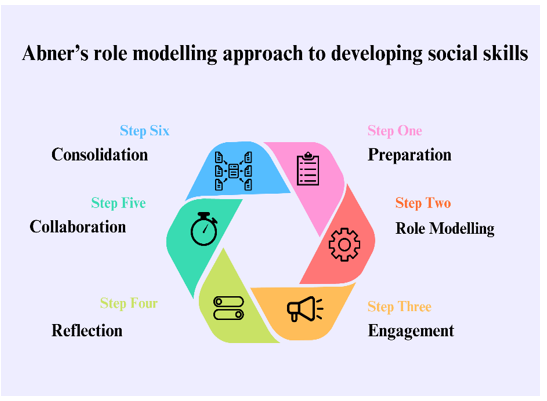
Figure 1. Ideas from practice
The method of role modelling in this case does not amount to a mechanical demonstration of how to draw or how to arrange the page. Its true meaning is that the teacher becomes a living bearer of values, which children internalise through observation and shared experience. In primary school age, imitation functions as a natural mechanism of learning; therefore, every demonstration of attitudes such as patience, respect, and responsibility towards the collective task is internalised by pupils as a model of social behaviour. The application of the method unfolds within a clear pedagogical logic. The process begins with the creation of an observational situation. The teacher works alongside the class, performing the same task. In the given case, when pupils draw a tree, the teacher also draws a tree but emphasises the importance of preserving and valuing it. Here, it is not the drawing itself but rather the attitude that becomes the principal bearer of the educational message. Subsequently, pupils move on to independent work, during which the teacher’s personal example already functions as an invisible regulator. In this way, they imitate the calm rhythm, the attention to detail, and the respect for the shared space. The subsequent step is the pedagogical conversation. This is not a formal discussion of the drawings produced, but rather a reflective dialogue that reveals the moral significance of the task: if the tree must be preserved, then friendship must equally be preserved; if nature requires care, then human relationships likewise demand responsibility. In this way, the artistic activity evolves into an educational act. The method does not conclude with individual expression but progresses towards a collective experience. The pupils create a shared composition a “forest of friendship” in which each tree takes its place alongside the others. This project-based form strengthens the sense of belonging and teaches that an individual contribution acquires true value only when interwoven into the common whole. At the end of the lesson, the teacher once again offers a personal example, evaluating not the individual drawings but rather the effort, attentiveness, and care invested in the process. The pedagogical significance of the role-modelling method in this context is twofold. On the one hand, it provides security and direction for quieter pupils, who struggle to express themselves verbally but are able to open up through creative activity. On the other, it functions as a form of prevention against challenging behaviour, as it channels the children’s energy into constructive and collectively meaningful actions. The teacher’s personal example ensures that values do not remain abstract but are instead experienced and internalised within a concrete pedagogical act.
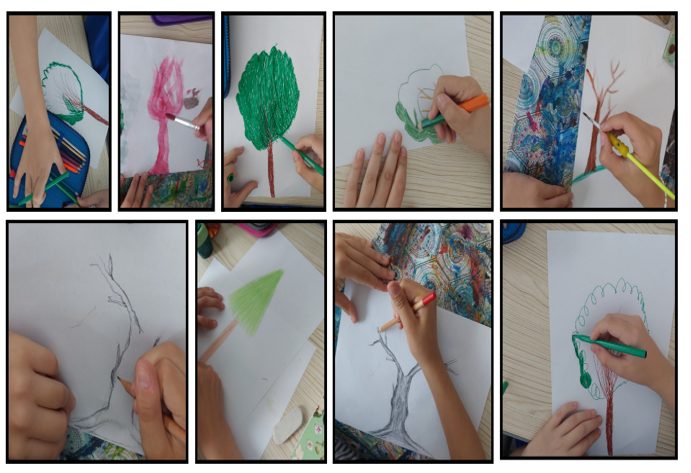
Figure 2. Student drawing as part of the operational process
Results
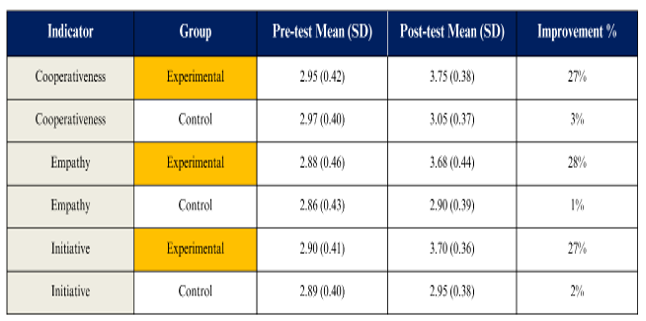
The study was conducted in a metropolitan school in Sofia during the second term of the 2024–2025 academic year, over an eight-week period. A total of 100 students participated, evenly distributed between an experimental and a control group. The experimental group comprised classes 3 “b” and 4 “b”, while the control group consisted of classes 3 “a” and 4 “a”. The assessment focused on three indicators of social competence: cooperativeness, empathy, and initiative. Measurements were carried out at the beginning and at the end of the period using a five-point Likert scale. In the experimental group, a significant improvement was observed across all indicators. Cooperativeness rose from 2.95 at the pre-test to 3.75 at the post-test (+27%). Empathy increased from 2.88 to 3.68 (+28%). Initiative improved from 2.90 to 3.70 (+27%). By contrast, the control group showed only minimal changes: cooperativeness increased from 2.97 to 3.05 (+3%), empathy from 2.86 to 2.90 (+1%), and initiative from 2.89 to 2.95 (+2%).
Table 1. Changes in cooperativeness, empathy, and initiative in experimental and control groups
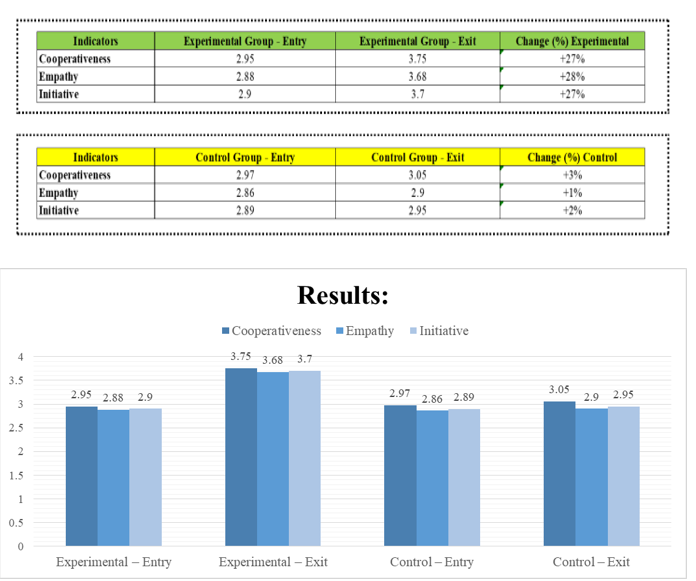
Figure 3. Comparative results
To assess the strength of the applied pedagogical model, effect sizes were calculated for each indicator. In the experimental group, Cohen’s d values exceeded 1.70 across all indicators, indicating a very strong effect. In the control group, effect sizes remained below 0.20, reflecting negligible change. These results indicate that the observed progress is associated with the application of the pedagogical model rather than with routine instructional factors.
Discussion
The results clearly demonstrate a substantial difference between the development of the students in the experimental group and those in the control group. While the control group registered only minimal progress, which can be explained by the natural accumulation of experience and routine learning practice during the second school term, the experimental group exhibited a distinct and systematic growth across all measured indicators. The most significant improvement was observed in empathy (+28%), reflecting heightened sensitivity to the experiences of others, the ability to understand different perspectives, and stronger social adaptability. This outcome can be interpreted as an indicator of the successful impact of targeted pedagogical approaches that create situations for sharing, mutual support, and collective experience. Cooperation and initiative, which also increased by 27%, testify to the formation of an active student stance, the assumption of responsibility in group activities, and a greater inclination toward collaborative problem-solving. This development is particularly important in the context of contemporary educational practices, which emphasize teamwork and social skills as key competencies for students’ future. The contrast between the two groups can be explained by the fact that, while the control group lacked additional pedagogical stimuli, the experimental group engaged in targeted activities that highlighted the value of cooperation and personal initiative. This clearly demonstrates that pedagogical tools, when methodologically grounded and systematically applied, hold genuine potential to positively influence students’ social development. From a theoretical perspective, the results confirm contemporary concepts of social learning and constructivism, which stress that peer interaction is central to development. The practical findings support the claim that social competencies do not emerge spontaneously but require deliberate pedagogical intervention that creates a favorable environment for their practice and reinforcement.
Table 2. Mean pre-test and post-test scores with percentage improvement for collaboration, empathy and initiative
Conclusion
The findings of this study confirm that the development of social competence in pupils is not an incidental by-product of the educational process but a pedagogical goal that can be deliberately pursued through carefully structured practices. The substantial progress recorded in cooperativeness, empathy, and initiative shows that these competencies can be intentionally cultivated when learning activities are aligned with the developmental and psychological characteristics of learners. Such outcomes hold particular importance in contemporary education, where social skills are recognised as essential for preparing pupils to meet the demands of a rapidly changing and interconnected society. The contrast between the experimental and control groups underscores the decisive role of systematic and methodologically sound pedagogical approaches. The study therefore contributes in two directions: it provides empirical confirmation of theoretical perspectives on social learning, and it offers a replicable model that teachers can integrate into everyday practice. The significance of this research lies both in its theoretical grounding and in its applied value. By demonstrating the transformative potential of intentional educational strategies, it affirms the responsibility of educators to design environments that promote collaboration, empathy, and initiative, equipping pupils with competences essential for meaningful participation in democratic societies and within global communities.
NOTES
- (2019). Thriving in a digital world. Paris: OECD Publishing.
- Kisida, B., Bowen, D. (2019). New evidence of the benefits of arts education. Brookings Institution.
- How Drawing and Painting Support Childhood Mental Health.
REFERENCES
Bandura, A. (1977). Social learning theory. Prentice Hall.
Boone, H. N., & Boone, D. A. (2012). Analyzing Likert data. The Journal of Extension, 50(2), https://doi.org/10.34068/joe.50.02.48
Cain, S. (2013). Quiet: The power of introverts in a world that can’t stop talking. Crown Publishing Group.
Chavdarova-Kostova, S., Delibaltova, V., & Gospodinov, B. (2018). Pedagogika (3rd rev. ed.). St. Kliment Ohridski.
Degiano, B., Demas, N., Johnson, J., et al. (2024). Voices of introverted CYC students: A course-based qualitative inquiry into the lived experiences of introverted students in the classroom and the field. European Journal of Education and Pedagogy, 6(2), 48 – 52.
Dimova, B. (2025). Lego education in preschool age. KNOWLEDGE – International Journal, 68(2), 297 – 302.
Laney, M. (2005). The hidden gifts of the introverted child: Helping your child thrive in an extroverted world. Workman Publishing.
Richman, N. (1993). Communicating with children: Helping children in distress. Save the Children Press.
Ryder, M. (2025). The quiet learner of the UK art classroom. International Journal of Art & Design Education, 44(2), 447 – 461. https://doi.org/10.1111/jade.12549.
Schonert-Reichl, K. A. (2017). Social and emotional learning and teachers. The Future of Children, 27(1), 137 – 155.
Scully, J. (2000). The power of social skills in character development: Helping diverse learners succeed. National Professional Resources.
Dr. Avi Abner, Assist. Prof.
ORCID iD: 0009-0004-1756-0554
Burgas state university „Prof. Dr. Assen Zlatarov“
Burgas, Bulgaria
E-mail: avi-abner@uniburgas.bg
>> Download the article as a PDF file <<